• No Barriers to Fun!

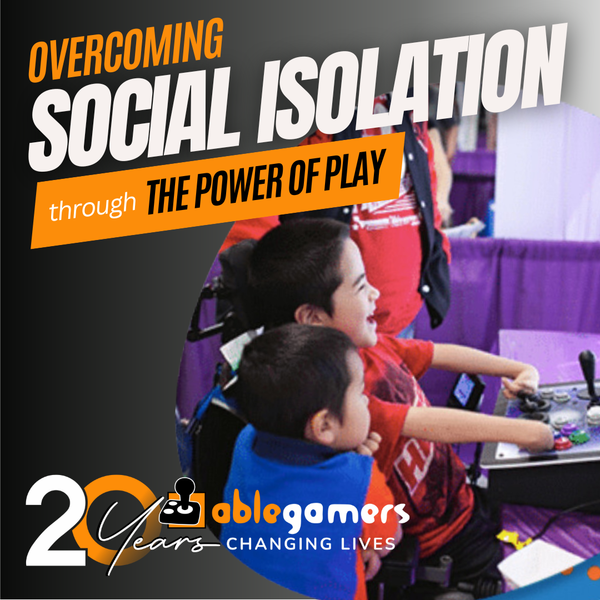
    We met our friend Giddeon at the AbleGamers Accessibility Arcade in Atlantic City, New Jersey. When he first sat down with the AbleGamers crew, Giddeon didn't want to play any games. He told us that with his disability gaming was difficult. Giddeon has a rare disease that caused the growth of his arms .. Read More
  • A Window to the World

    Shepherd University invited the AbleGamers Foundation to come on campus and do one of our Accessibility Arcades for the students and local disabled community. The event was a roaring success with hundreds of children and adults coming out to see the technology and in some cases experience gaming the first time. Read More
  • 1
  • 2

AbleGamers Talk to the Maker of "Stem Stumper" A Blind Accessible iPhone Game, Kwasi Mensah

blind_iphone_app

{sidebar id=1}Though they’ve certainly opened a floodgate for a bevy of more simplistic, casual games, Apple’s touch devices have traditionally not been rich with content usable for those with sensory or fine motor impairments. This is what makes Ananase Productions – a new indie games startup here in Cambridge, MA – so interesting and exciting. Their first game, a blind-accessible puzzler for iPhone and iPod

Touch, uses a dynamic layered soundtrack to help the player guide “Mimea the vine” through a huge variety of levels, all the while using acorns, sling shots, and sprinklers to overcome several types of obstacles. The goal is to use all tools at your disposal to try for huge score combos – it’s addictive fun. The game packs in support for iOS’ VoiceOver utility to give sight-impaired players a leg up, but is also fantastic to look at, ensuring that sighted players get some eye candy.

This week, I headed down towards Cambridge’s “gaming row” (home to Harmonix, Demiurge, Zygna Boston, and more) to chat with friend and fellow Boston dev Kwasi Mensah, founder of Ananse. We talked about his motivation behind creating a game for this important audience, why inclusion and diversity are core tenants of his new studio, and why the iPhone was a great choice as the game’s platform.

blind_iphone_app_splashJohnny Richardson: What made you want to make a game accessible to the blind, and the disabled in general, for that matter? What were some directions you considered taking Ananse before going for the diversity and accessibility ideas?

Kwasi Mensah: So, Ananse Productions’ tagline is “Games for the Rest of Us”. I wanted to make games that were kind of more diverse than the gaming as I’ve seen it. There’s actually an interesting story about something I heard at my last job that made me think, “Okay, this is a problem.” And I think at Boston GameLoop too there were a couple sessions on diversity in gaming and women in gaming that made me really interested in it. I knew I wanted to make the game accessible because diversity is not just a cultural aspect but a people aspect, but as I looked into what making a game accessible meant, it seemed like a good first place for something to get our feet wet, get our product out there, and giving us a good basis for learning what it takes to make all of our other games accessible.

JR: …so was this the only direction you ever thought you were going to go in, or did you originally think of making just a “normal” iPhone game?

KM: No, it was never about making a normal iPhone game. By the time I actually sat down and started, you know, figuring out what I was going to do with the iPhone, doing something accessible was always at the base of what we were going to be working on.  I was going to add a bunch of other stuff to it; to address the cultural aspect of it. But then keeping our scope nice and tight for our first project, I kind of shuffled all of that stuff off. And I think we have a stronger game because of it.

JR: Yeah. In a lot of ways Stem Stumper is a very classic sort of point A-to-point B top-down puzzle game, but what were some of the more challenging parts of the design phase given that you can be sight-impaired/blind and still play it effectively?

KM: Good question. One of the things that I kind of tried to focus on was to make the puzzle more about what to blow up. Not where things are, but the order in which things should blow up. And figuring out how to make it easy to find stuff on the field took a long while. We played around with having the music volume change as you got closer [to objectives in the puzzles], but then that’s hard to tell. Then we tried messing with pitch, but then if you’re not a music nerd, you’re not going to pick up on that. Actually, Eitan [Glinert] from Fire Hose Games was really helpful in kind of initially suggesting having layers of music come in and out as you get closer or farther away. I was initially afraid of positioning it as a music game, which I didn’t want because there are too many other players in that field, but I think we’ve pulled it off without making it seem like it’s in Rock Band territory.

JR: Right, and it definitely doesn’t feel like a music game. In many ways the game is in its own, new category, but what similar works did you look at to nail down things like using sound cues to aid the player?

KM: So, it’s interesting, a lot of people want me to explain it to them as Minesweeper, but that’s one of the last games I thought of. It was more looking at Portal and Braid, and looking at how the set of mechanics you do in the game are small, but they have a bunch of interesting ways of piecing them together. And that’s kind of where we’re trying to go with Stem Stumper, with having the idea of a bomb blowing up, which maybe isn’t terribly innovative, but kind of making you scratch your head about doing them in the right order. And I think that’s a very Portal-esque problem to have people do.


JR: Yeah, totally. So why choose the iPhone as your platform? Obviously there are purely economic and business strategy reasons, but what’s attractive about the device from an accessibility view?

KM: it's a much bigger market. You know, [Ninentdo President] Iwata talked about how iPhone games are cheapening the market or making games seem cheap in consumer’s eyes. But I don't have to spend $2000 on a development kit to make a game that will hit more people than on the DS. To be fair, I already also owned a MacBook, and if you add up everything it takes to work on iPhone, it probably comes out to the cost of a dev kit. But I was sort of a Mac fanboy anyway [Laughs]. But accessibility-wise, iPhone has VoiceOver built into it, something none of the other mobile carriers have. I know on Google [Android] since it’s open-source, you can install one, but I don’t think there’s a huge blind user base on Android, and Windows Phone 7 actually caught a lot of flak for not including it because at some point I think they promised that they would have it, but they didn’t, and I think older versions Windows phones had it….

JR: Yeah, they did…

KM: …plus not only is there VoiceOver on the iPhone, but there’s actually a user base of blind people who use it, so they really like working with Apple tech.

JR: It seems to me like you were able to keep a good balance between gameplay that’s exciting for all core iPhone gamers, but not watering it down to achieve the high accessibility. Did you and the team set that as a goal from the start?

KM: Yeah, so I guess I believe that people aren’t afraid of gaming. For me, gaming has always been about giving players an interesting problem to solve, and then wrapping it in a context so that things make sense in that world. Look at a game like Diner Dash, actually a very complex game – you’re multitasking – there are people who love it because you’re solving interesting problems. Same thing with Bejeweled. You’re solving a very interesting problem, it’s just not dressed up in marines and shooting and killing, or in a context that only talks to your “straight white male gamer,” to borrow what that guy said about Dragon Age 2. So you can make games that are deep and still appeal to a lot of people, as long as you don’t put it in a context that scares them away.

JR: Given those goals, do you think that Apple does a reasonable job of making VoiceOver integration and other accessibility tools easy? What could be made simpler?

KM: There’s some small things on the API level that would make my life easier, but in general it’s actually not terribly hard, even if you’re using your own UI. I know that had we used Apple’s UI for the game, there’s pretty much just a checkbox that you check, and now things are setup for VoiceOver. But they also give you a good API for if you want to do it yourself, you can.

JR: Because you’re not using the SDK’s Interface Builder…

KM: Ya, the idea is I don’t want to root us just on the iPhone. I think it’s not terribly hard. Apple isn’t doing much during the approval process to make sure people are using the tech, but I don’t necessarily think that’s the wrong way to go about it. I think some apps are just fundamentally inaccessible. So if you have a paint/drawing app, even if you labeled everything properly [for VoiceOver], you’re drawing something on the screen. I don’t think it’s Apple’s job to force everyone to do it, because I just don’t think it works for every app.

JR: You’ve mentioned using the Web Content Accessibility Guidelines as a starting point for Stem Stumper’s design approach, since there’s no real best practices guide for games out there yet. Some folks out there, you know, have taken issue with that approach. What were you able to use from the WCAG that ended up working out as the game’s come together?

KM: It’s funny, when I playtest the game, the things that trip up sighted people are the same things that make the game better for blind people. One of the things I kind of wanted to mention in that [Gamasutra] article I wrote was that accessibility equals usability – everything you do to make it more accessible makes it more usable, plus or minus VoiceOver support. There’s just such an overlap. Everyone talks about “the Holy Grail” – is players being able to pick up your game and play it right away. I think if you follow the Web Content Accessibility Guidelines, you’re going to get that. But I also know there are people in the [IGDA Game Accessibility] SIG that don’t want the WCAG getting picked up for games. The whole frustrating thing about it is as someone who is a professional game developer, and who comes from professional game development, I’m used to having TRCs [Technical Requirements Checklist] and TCRs [Technical Certification Requirements] which is the checklist of items that Sony, Microsoft, Nintendo say, “you must do this in order to ship the game.”

JR: And then you’ve got all the Best Practices guides about “this should work this way” and “make it use the Wiimote like this”.

KM: Right, and I know Tara, the head of the Accessibility SIG, is starting to work with the Quality Assurance SIG in order to come up with a list that actually helps developers. Until then, WCAG seems the best list of that sort for now, and I’ll let people who have more experience debate about that.

JR: And I definitely agree with you there, since so far it’s the only thing we’ve got. I’m interested – what’s the reaction been from gamers as a whole? Not just your testers, but folks at PAX East, devs at the “Made in MA” party beforehand, etc?

KM: It’s weird – it has this moment where it has to click in your head. And we’ve been working on the tutorial to make sure that click happens sooner. But as soon as the click happens for people, they don’t give it up. We had an event a couple weeks ago (you were there), and I would give the game to someone and the only thing that would make them hand it back to me was the game crashing. And sometimes I had to sit there and explain the game to them myself, because the tutorial wasn’t entirely helpful yet, but once they “got it”, they’d just sit there and keep playing. And these are also non-gamers. Frankly, I‘m actually more excited about getting non-gamers excited about this game. I know “casual” is sort of a dirty word, but people who aren’t…normally associated with games.

JR: Especially if you’re blind, and there’s just no game on the iPhone for you, this will be that one thing…

KM: There are audio-only games…Aurifi, Papa Sangre are kind of the big ones. The one thing we wanted to watch out for was that – those games have no visual component. Aurifi does a little bit, but not related to gameplay. We didn’t want to scare away sighted players; we wanted to make a game where they can sit down and say, “Oh, this is awesome.” I am OK if someone doesn’t go to AbleGamers and read this interview. If Random Joe just hears from his friend that this is a good game, and doesn’t realize you can play it with VoiceOver on, or that sonar mode was made for the blind, and just thought it was a good game too, that’s what I am really aiming for.

JR: Yep, totally. And Jen – your artist – she did a great job with the artwork…

KM: Yeah! A big thing too is that we also know that only 90% of people who are legally blind have no sight whatsoever, so that means you still have art. Just because someone has VoiceOver on doesn’t mean they’re not going to appreciate seeing the Angry Acorn get upset and blow himself up.

JR: Ok, so is there anything else you’d like to add?

KM: The one thing that has been kind of the marketing challenge for me is as soon as you say “blind accessible”, people say, “Oh, I guess I’ll try that out, but it’s not really meant for me.” And that’s why we’ve been on the campaign to beta test it, get as many people playing the game – so that they understand that the game was designed to be played by the blind, but that doesn’t mean it isn’t for everyone. Sighted people are welcome to it – it’s not like it’s an experience meant only for the blind, and you’re intruding if you play. 

Add comment

Security code
Refresh

Comments   

 
0 #3 COMMENT_TITLE_R E AbleGamers Talk to the Maker of "Stem Stumper" A Blind Accessible iPhone Game, Kwasi MensahHales 2011-04-26 21:27
My 7 year old daughter is Legally Blind, I am so excited we found this app! Thank you :-)
 
 
0 #2 COMMENT_TITLE_R E AbleGamers Talk to the Maker of "Stem Stumper" A Blind Accessible iPhone Game, Kwasi MensahJohnny 2011-04-07 10:40
Yep, Stem Stumper gets a high recommendation from me. Ananse really pulled it off.
 
 
0 #1 COMMENT_TITLE_R E AbleGamers Talk to the Maker of "Stem Stumper" A Blind Accessible iPhone Game, Kwasi MensahMark 2011-04-07 07:37
I got a chance to play this game at PAX and it was great for sighted gamers, and blind gamers. It was lots of fun, and KM is real cool to boot!