• No Barriers to Fun!

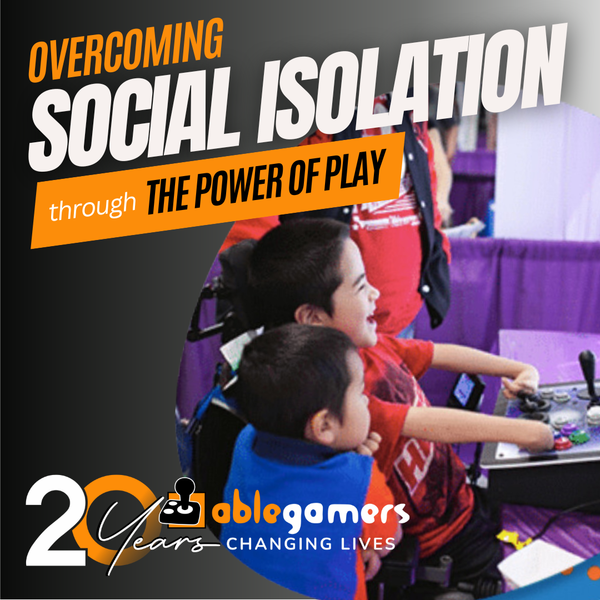
    We met our friend Giddeon at the AbleGamers Accessibility Arcade in Atlantic City, New Jersey. When he first sat down with the AbleGamers crew, Giddeon didn't want to play any games. He told us that with his disability gaming was difficult. Giddeon has a rare disease that caused the growth of his arms .. Read More
  • A Window to the World

    Shepherd University invited the AbleGamers Foundation to come on campus and do one of our Accessibility Arcades for the students and local disabled community. The event was a roaring success with hundreds of children and adults coming out to see the technology and in some cases experience gaming the first time. Read More
  • 1
  • 2

Play Warcraft III for Research : An Interview with Chris Quinn

warcraftiii_3{sidebar id=1}Recently, AbleGamers was contacted by Chris Quinn, a research student preparing to do his thesis on improving the accessibility of the standard game from within. This thesis will take several volunteers playing the game Warcraft 3 on the map defense of the ancients to determine its accessibility and how Chris can improve it.

AbleGamers' Steve Spohn sat down with Chris to discuss a little bit more about the project. Check out the interview and read on below to see how you can help shape the future of Warcraft 3 and accessibility!

Steve Spohn: What was the inspiration behind getting into adapting games for the disabled?

Chris Quinn: I began a career in the field of accessibility at George Mason University after joining a fraternity, Pi Kappa Phi, whose philanthropy is helping people with disabilities. As the webmaster for our chapter, I wondered if we could make our website accessible for people with disabilities. So, I took a graduate level class in web accessibility to learn how to do it and ended up getting hired by the instructor to redesign one of GMU's department web sites and make it accessible.

Fast forward a couple years after getting some real-world experience, I applied to the Savannah College of Art and Design because I was interested in learning how to design games. I was attracted to the Interactive Design and Game Development program because it was a hybrid of the two fields. It turned out to be an excellent choice because I could take classes in both tracks towards my Master of Arts. In fact, I enjoyed the program so much that I stayed on for a second year to pursue a Master of Fine Arts, which is where this thesis came into play.

From the beginning, I wanted to marry my skills and experience in the web accessibility arena with my passion for playing games. Initially, the idea of making a universally accessible

SS: Was there a particular reason you chose DotA?

CQ: I chose Defense of the Ancients (DotA), a custom map for Warcraft 3: The Frozen Throne, because it's the game I've played the most over the past 4 years. I think it's important for me to be a subject matter expert in order to identify user tasks and create testing instructions. Also, Warcraft 3 comes with a map editor, so it's possible for me to actually make coding changes to the game based on user feedback. I think this approach is enormously better than creating some abstract prototypes in Adobe Flash because people can actually play the custom maps as long as they have Warcraft 3: The Frozen Throne installed.

SS:What do you hope to prove in your thesis and in real life?

CQ: This thesis intends to illustrate the plausibility of pioneering a process model for the creation of a computer game accessibility toolkit that aims to improve the independent accessibility of a mainstream real-time strategy computer game for players with physical disabilities. The ultimate goal is to make the development of accessible games accessible to game developers, so they may start incorporating accessibility into their development processes and the resultant games would be more accessible than those on the market today.

SS: Have you spoken to Blizzard directly and if so what is their opinion of your project?

CQ: I have not spoken to Blizzard directly yet, but hope to through networking contacts once the results are in from the initial round of testing.

SS: What will you have volunteers do?

CQ: I will have the volunteers play DotA using a specific set of instructions. The instructions will essentially outline user tasks that are required in order to play the game. Some examples of user tasks include navigating between buildings, selecting a hero, buying items, upgrading skills, activating skills, activating items, moving the hero, attacking a single enemy, attacking multiple enemies, and controlling multiple units. In order to be consistent and to keep things simple, participants will be asked to play in single player mode. This will eliminate any variances from playing against bots or real players. After all, this is a proof of concept.

SS: Have you done any testing so far and if so what were the results that you can reveal?

CQ:I have not done any official testing yet, but I know of several existing accessibility barriers, such as not being able to control a hero without using the mouse.

SS: What needs to happen in order for this thesis and project to become a "success"?

CQ: This thesis will be a success no matter what because it's not trying to prove anything. It's just evaluating the possibility of using this process to identify and fix accessibility barriers for a particular user group, in this case, gamers with physical disabilities. So, it will be a success as long as it completes its mission.

SS: Do you have a backup plan?

CQ: Yes, I do. I have been working on my own custom map prototype in my top-secret laboratory, which I will unveil in the event that Blizzard chooses not to accept my invitation (which has not been sent yet). I have made some small strides towards creating a keyboard accessible map, but I don't really know what I am doing. This is a why the assistance of a Warcraft 3 World Editor coding expert would be greatly appreciated. Plus, they would get industry recognition for collaborating with SCAD and AbleGamers.

What would you be doing for game accessibility after this project and will it be a direct result from your findings in this test? If so or not, please explain what and how.

Regardless of the results, I would like to create as much awareness for gamers with disabilities as possible and share my experience with students to inspire them to be interested in game accessibility. From a career standpoint, I would be very interested in collaborating with game designers and developers as an accessibility consultant. If there's one thing I have learned from this experience so far, it's that people can accomplish more working together than they can on their own.
You would like to be an accessibility consult yet you are not disabled yourself. What do you feel is the advantage of not being disabled but fighting for accessibility for the disabled? Have you attempted any simulations to understand what some of the bigger disability types experience during videogames?

I do not think that there is any advantage to not being disabled myself. I am not a spokesperson for people with disabilities by any means, but an advocate for accessibility and equal rights for everyone, regardless of ability or disability. I don't think it's fair to discriminate against or cater to a particular group of people just because they do things differently. If a duffel bag at a sports equipment store is on a shelf too high for someone to reach, then I believe it should either be on a shelf low enough for everyone to reach or a shelf that is too high for everyone to reach. Reality is such that sometimes a store employee on a ladder is the only way to get the duffel bag down. I think the point is that we are all on the same mission fighting for the same cause because it's morally and ethically the right thing to do.

As far as simulations go, once I made a rough prototype of a self-voicing Flash game that was accessible to players with visual disabilities. In order to demonstrate it in front of the class, I turned off my monitor and played the game while it displayed on a large projection screen for everyone else to see. It was a very interesting experience and quite foreign to me. I also take this approach when testing web sites with JAWS, a software program designed to voice a web page through the computer speakers. As far as my thesis goes, during the development of my top-secret custom map mentioned previously, I have tested my ability to move a hero around the screen using nothing but my keyboard. It wasn't as smooth or intuitive as I had hoped, but certainly a step in the right direction because it is some proof that Warcraft 3 can be made keyboard accessible.

So, here is how you can help. Visit Chris's blog at http://quinn-thesis.blogspot.com/ for the full details on this project. In summary, Chris needs 3 to 5 volunteers who can play Warcraft 3 and give him feedback on how they play the game. He could also use the assistance of an experienced Warcraft three map builder.

To volunteer to help Chris send him an e-mail at This email address is being protected from spambots. You need JavaScript enabled to view it. with the subject "Warcraft three thesis" - space is limited to be involved with this project, so make sure to start up today!

Chris QuinnChris Quinn

Add comment

Security code
Refresh