• No Barriers to Fun!

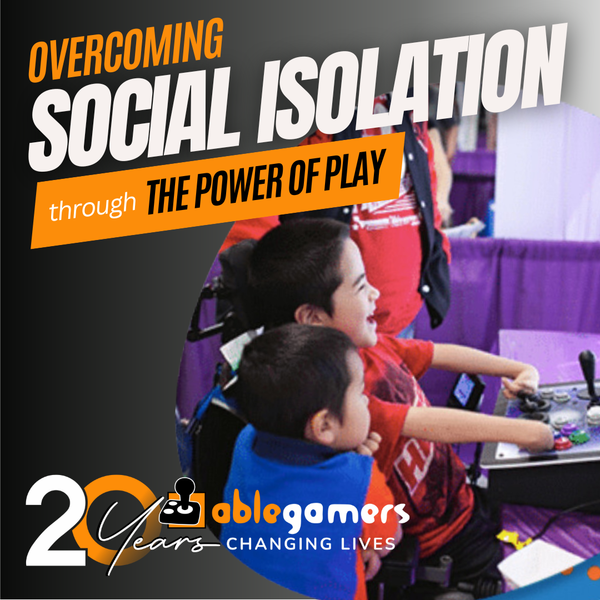
    We met our friend Giddeon at the AbleGamers Accessibility Arcade in Atlantic City, New Jersey. When he first sat down with the AbleGamers crew, Giddeon didn't want to play any games. He told us that with his disability gaming was difficult. Giddeon has a rare disease that caused the growth of his arms .. Read More
  • A Window to the World

    Shepherd University invited the AbleGamers Foundation to come on campus and do one of our Accessibility Arcades for the students and local disabled community. The event was a roaring success with hundreds of children and adults coming out to see the technology and in some cases experience gaming the first time. Read More
  • 1
  • 2

About the AbleGamers Foundation

Since 2004, the AbleGamers Foundation, a 501(c)(3) public charity, has served more than 56 million members of the disabled community by advocating greater access in video games. Today, AbleGamers is a leader in the development of equipment, programs and services to those living with disabilities, hardships, and quality-of-life issues that are a result of chronic illness or trauma. It is our goal to ensure that all people, regardless of their disability, can use gaming as a tool to have enriched social experiences with friends, family, and the world at large. 


Fable II

Fable II Hot

Editor rating
 
2.3
User rating
 
0.0 (0)


Accessibility At A Glance Fable II

2.3

   
Percision > Yes You will need precision to play
One-Handed > No Avoid this game
Deaf Gamers > Yes Ummm, I would read the detailed review
Subtitles > Mostly Character text is present but not ambiant
Colorblind > No Not so sure this is the game for you

About the Game

Class
Commercial
Genre
Maker
Lionshead Studios
Release Date
October 21, 2008
Official Website
Multi-player
No

fable_iii_banner


Fable™ II is the true sequel to the wildly successful original that sold more than 3 million copies, offering even more choices and building on the core gameplay theme of "Fable," where a player’s every decision continually defines whom they become. "Fable II" is an action role-playing game (RPG) that truly allows players to live the life they choose in an unimaginably open world environment.


Set 500 years after the original, "Fable II" will provide gamers with an epic story and innovative real-time gameplay, including a massive amount of freedom and choice to explore a vast collection of dungeons, catacombs and caves in the world of Albion.

Image Gallery

Fable II
Fable II
Fable II

Editor review

Fable II 2010-12-10 15:48:18 Scott Puckett
Overall rating 
 
2.3
Mobility 
 
1.0
Visual 
 
2.0
Hearing 
 
5.0
Scott Puckett Reviewed by Scott Puckett    December 10, 2010
Last updated: December 10, 2010
Top 10 Reviewer  -   View all my reviews

Fable II Game Accessibility Review

It isn’t hard to argue that one of the most significant changes in video game development over the last decade or so is including meaningful moral / ethical decisions which alter the game environment for the player. This evolution has resulted in some truly astonishing games like the various games in the Fallout and BioShock series. While Fable II isn’t quite as polished, deep or accomplished as those two, it’s still a worthwhile title, especially in the Platinum Hits line since it comes with both DLCs.

Fable II is set in a land called Albion in a period in which firearms have been invented but magic is still present, even if it’s largely forgotten or dismissed as myth. It begins with the player as a young child and quickly moves forward to the main part of the story when the player is a young adult. Choices made as a child determine the game environment in which the player operates; even seemingly small decisions can drastically alter Albion for better … or worse.

For the most part, the game consists largely of these decisions – while there are quests and missions and jobs, a player’s decisions determine the player’s appearance, what the world looks like, who has power and who does not. As a result of the reliance on moral and ethical choices, the game offers vast replay value for patient players who don’t mind a game that can feel slow at times, and even repetitive as players improve their proficiency in jobs like blacksmithing and bartending. Players can also ignore jobs and simply take on missions and quests to proceed directly through the story; while decisions will still play a major role, the player won’t see as much impact simply because they won’t be exploring as many locations.

In short, Fable II is a value purchase set in a world which is both deep and engrossing and very much worth exploring and enjoying, especially for players who enjoy games set in a more open world environment, allowing players to proceed as quickly or slowly as they choose.


Game Accessibility
Unfortunately, Fable II has accessibility concerns. There are two specific points which disabled gamers will likely find very helpful – first of all, it is impossible to fall off ledges or cliffs; the game prevents players from falling off the edge of anything, and will only allow a player to jump over railings, ledges, etc. if the player can land safely. Furthermore, the player has to press a button to make the jump. In other games, falling off ledges that were hard to reach can be a problem. This is not the case with Fable II.

Furthermore, Fable II uses a save system which allows a player to save anywhere and restarts the game where the player stopped instead of returning to a checkpoint. In short, you can stop whenever you like and resume exactly where you left off. In addition, the game usually autosaves after completing a quest or mission.

Deaf gamers and gamers who use subtitles will generally find the game acceptable; while subtitles are not letterboxed, players can turn them on before the game starts, they are usually present for quest and mission-related dialogue and they identify the speaker. The font used is a decorative typeface representative of the period, not a sans serif font, and may be difficult for some people to read. Ambient chatter is not subtitled, so once a player receives a quest or mission, subtitles aren’t really a concern.

Gamers with a form of color blindness will likely find the game more difficult as every job in the game uses red and green for meaning; these mini-games require the player to press a button at a certain time, indicated by the color green. Pressing the button at other times results in failure. The game also uses a mechanic called expressions, meaning actions that the player can trigger like smiles or dancing, and some of these expressions can be extended to achieve a better result. Much like the jobs, releasing the button at the right time – again indicated by green – offers the best outcome. However, players with a form of blue-yellow color blindness will also experience problems as noted below.

These mini-games will also likely present problems for players with precision concerns because they require the player to perform a certain action within a small amount of time and the game doesn’t offer any mitigation for players who may have difficulties with timing. More frustrating and problematic are floating orb puzzles that players have to solve, some of which are crucial to completing missions. Essentially, magical floating spheres act as keys to unlock certain areas; most of these puzzles require a player to either use a melee weapon, ranged weapon or spell to activate them and move the sphere toward the object it unlocks, but these puzzles are color sensitive, using a blue outline for melee weapons, a yellow outline for ranged weapons and a red outline for spells, and they can also be time sensitive.

In one particularly frustrating example, a floating orb had to be targeted and hit with melee weapons, ranged weapons and spells approximately 10 times in different locations in a single room in the Knothole Island DLC; the puzzle required running to strike the sphere with a melee weapon and praying that ranged weapons and spells actually targeted it. If any attack missed the sphere, it returned to the starting point and the player had to begin from scratch. Similar puzzles exist in the main storyline of the game and they are no less problematic, both for precision concerns and their use of color to indicate meaning.

Generally speaking, combat with ranged and melee weapons offers auto-targeting, and spells in combat can often be used as an area effect attack (i.e. targeting a certain number of enemies in a defined radius around the player), but all combat is real-time. While it can be paused, it does not offer the player the opportunity to slow it down.

One-handed gamers may find this game somewhat accessible using basic attacks in combat; motion is controlled by the left stick, the camera is controlled by the right, and combat is controlled using the X button for melee attacks, the Y button for ranged attacks and the B button for magical attacks. Generally, Fable II will automatically target enemies, allowing the player to press the desired button rapidly. Furthermore, it’s possible to back off from combat a bit to obtain a better strategic position, or to simply turn to face other enemies. Using a magical attack without targeting will trigger an area effect spell, attacking enemies in a radius around the player. However, unlike many games, there is only one controller layout – it cannot be remapped and players cannot deviate from the single defined scheme. Finally, the puzzles noted above that may present challenges for players with a form of color blindness or with precision concerns will likely present similar challenges for gamers with use of only one hand to the movement and attacks required.

Ultimately, Fable II is enjoyable, but it comes with significant accessibility concerns – concerns which, in some cases, may prevent players from completing the game.


At A Glance

Precision: Combat generally offers auto-targeting, but some puzzles which are in the main quest line require a significant amount of precision. There is no mechanism to pass by them for gamers who cannot complete them due to precision concerns; since these puzzles can effectively prevent a player from finishing the game, they are a game-breaking mechanic. Recommend rating of 0 out of 10.

Deaf Gamers: Subtitles are not letterboxed and are not in a sans serif font, instead using a stylized font seemingly intended to represent the time period which may be difficult to read. Speakers are identified and quest and mission-related narration is subtitled. Ambient chatter is not. Recommend rating of 5 out of 10.

One-handed: Controllers cannot be remapped and the game only provides one controller layout. Combat is less fast-paced than first-person shooters and combat is controlled through the X, Y and B buttons for basic attacks. However, the puzzles that are likely to present challenges for gamers with precision concerns and color blindness are also likely to be frustrating for gamers with use of only one hand and may prevent them from finishing the game since there is no bypass mechanism. Recommend rating of 0 out of 10.

Subtitled: Subtitles are not letterboxed and are not in a sans serif font, instead using a stylized font seemingly intended to represent the time period which may be difficult to read. Speakers are identified and quest and mission-related narration is subtitled. Ambient chatter is not. Recommend rating of 5 out of 10.

Color Blind: The game uses red and green for meaning at the same time, as well as blue and yellow. Some puzzles which can prevent players from completing the game use these colors and do not offer any way for players with color blindness to bypass them. Recommend rating of 0 out of 10.

Checkpoint / Save System: Players can save anywhere at any time and resume where they stopped. In addition, the game often autosaves after completing quests or missions. Recommend rating of 10 out of 10.

Was this review helpful to you? 
00
Report this review
 

User reviews

There are no user reviews for this listing.

To write a review please register or log in.
 
Powered by JReviews

Add comment

Security code
Refresh